Overview
In Thailand, the land title is one of the most important aspects of any property due diligence. Unlike Switzerland, where ownership is generally clearly traceable through the land register, Thailand has several types of land documents with very different levels of legal certainty.
For purchasers, investors, heirs and long-term tenants under a leasehold arrangement, it is essential to know whether the document is a full ownership title, a certified right of use or possession, a provisional land record, or merely a weak document that cannot be transferred with certainty.
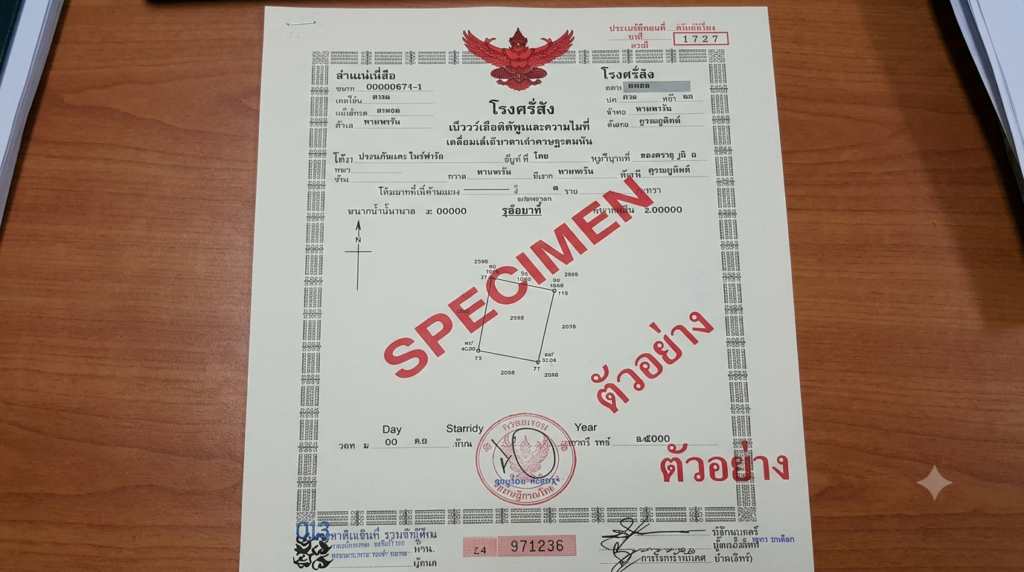
The Chanote for land and the Condominium Title Deed for condominium units are particularly important. The Chanote is regarded as the highest form of land title in Thailand, whereas Nor Sor 3 and Nor Sor 3 Gor are certified rights of possession or use with differing levels of survey accuracy.
Why Land Titles in Thailand Are So Important
Anyone buying or leasing land, a villa, a house, a resort development or a condominium in Thailand on a long-term basis should never rely solely on the contract, the purchase price or the seller’s description. What matters is which rights are actually registered with the competent Land Office.
The land title shows, among other things:
- who is registered as the person entitled to the land,
- what type of right exists over the land,
- whether the land may be sold, transferred, encumbered or leased on a long-term basis,
- whether mortgages, lease rights, servitudes, usufructs or rights of superficies are registered,
- how precisely the boundaries of the land are defined,
- whether the land is legally suitable for the intended purpose.
The title is particularly important in relation to long-term leases, usufructs, rights of superficies and mortgages. In Thailand, such rights generally provide practical security only when they can be registered against an appropriate title and certificates at the Land Office. Weak possession documents or mere tax receipts are not sufficient.
The Main Types of Land Documents in Thailand
Thailand has several types of land documents. Not every document represents full ownership. The name of the document alone is therefore not sufficient; it must always be examined together with the original title, the Land Office registration and the actual use of the land.
| Document / Title or Certificate | Thai Designation | Meaning | Legal Certainty |
| Chanote | Nor Sor 4 Jor / น.ส. 4 จ. | Full land title with precisely surveyed boundaries | Highest level of certainty |
| Nor Sor 3 Gor | น.ส. 3 ก. | Certified right of possession/use, relatively accurately surveyed | Good, but not equivalent to Chanote |
| Nor Sor 3 | น.ส. 3 | Evidence of possession with less precise boundaries | Medium; increased due diligence risk |
| Nor Sor 2 | น.ส. 2 | Provisional right of use or preferential right | Not suitable for an ordinary purchase |
| Sor Kor 1 / possessory rights / tax receipts | ส.ค. 1 / Por Bor Tor | Very weak evidence, not a full land title | High risk |
| Condominium Title Deed | Or Chor 2 / อ.ช. 2 | Ownership title for a condominium unit | Secure if the condominium is properly registered and the quota is complied with |
Red Chanote, Green Chanote and Black Garuda: What Do the Colours Mean?
In practice, terms such as “red Chanote”, “green Chanote” or “black Chanote” are often used. However, these terms are no legal term. They usually refer to the colour of the Garuda emblem on the Thai land document.
A red Garuda indicates the actual Chanote, namely Nor Sor 4 Jor.
A green Garuda generally indicates Nor Sor 3 Gor or Nor Sor 3 Khor. The expression “green Chanote” is therefore idiomatic and may be misleading.
A black Garuda usually indicates Nor Sor 3 or a similar, weaker form of land-use evidence. The boundaries are often less precisely defined, and additional steps may be required in connection with a sale, conversion or boundary issue.
For purchasers and long-term tenants, the important point is that the colour may provide an initial indication, but it does not replace verification with the competent Land Office. What matters is not the colloquial name, but the exact type of document, its registration and the specific entries on the front and back of the title.
Chanote: The Most Secure Land Title in Thailand
The Chanote, also known as Nor Sor 4 Jor, is the most important and secure land title in Thailand. It is regarded as a full ownership title for land. Land held under a Chanote is generally surveyed precisely, connected to the national cadastral survey system and marked by boundary posts on site. However, this title also carries a risk: specifically, land held under this title can be acquired by a third party through usucaption within 10 years.
A Chanote generally allows:
- the sale of the land,
- the transfer of ownership,
- the registration of a mortgage,
- the registration of a long-term lease,
- the subdivision of the land,
- the registration of certain rights in rem, where permitted by law.
For the purchase of land, a long-term lease or a project involving substantial investment, a Chanote is generally the preferred title. When purchasing a villa or house, it should also be verified whether the underlying land is in fact held under a Chanote.
It is important to note, however, that even a Chanote does not replace due diligence. It must be verified that the title is genuine, that the registered owner has the legal authority to dispose of the land, that no encumbrances exist, that the actual area corresponds to the information stated on the title, and that the land occupied by a third party. The back of the title is particularly relevant, as it may contain entries concerning registered rights and encumbrances, such as mortgages, lease rights or other registered legal transactions.
Nor Sor 3 Gor: Strong, but Not Equivalent to Chanote
Nor Sor 3 Gor is certified evidence of a right to use or possess land. It is stronger than a basic Nor Sor 3, but does not fully reach the level of a Chanote.
Land documented by Nor Sor 3 Gor has generally already been surveyed and aligned with neighbouring plots. It may be transferred, and certain rights may be registered. Unlike Nor Sor 3, a sale or transfer typically does not require a 30-day public notice period.
Nor Sor 3 Gor may be of interest to purchasers or long-term tenants where:
- the location is clear,
- there are no boundary disputes,
- the Land Office confirms the information,
- a later conversion to Chanote is realistically possible,
- the price appropriately reflects the increased risk.
Nevertheless, caution is required. Nor Sor 3 Gor is not automatically equivalent to a Chanote. Particularly for larger plots, rural land, resort developments or construction projects, it should be verified before signing the contract whether conversion to Chanote is possible and whether any third-party claims exist.
Nor Sor 3: Evidence of Possession with Increased Risk
Nor Sor 3 confirms a right of possession or use over a specific plot of land. However, its boundaries are often less precisely defined than those of a Chanote or Nor Sor 3 Gor. The boundaries frequently have to be reconciled with neighbouring plots, which may lead to disputes.
A sale or transfer of land documented by Nor Sor 3 may require a public notice period so that third parties can raise objections. This is precisely what makes the title riskier for purchasers.
The purchase or long-term use of land documented by Nor Sor 3 should therefore take place only after careful examination. The following points are particularly important:
- verification of the land boundaries,
- verification with the competent Land Office,
- clarification of any neighbouring claims,
- review of the previous possession history,
- verification of whether a later conversion to Nor Sor 3 Gor or Chanote is possible.
For foreign investors, Nor Sor 3 is generally more problematic than Chanote, particularly where long-term security, financing, resale or project development is intended.
Nor Sor 2: Not an Ordinary Ownership Title
Nor Sor 2 is a provisional land-use or preferential-right certificate. It permits the use of the land under certain conditions, but it is not a full ownership title. Nor Sor 2 is generally unsuitable for an ordinary property purchase. If a seller claims that a Nor Sor 2 can soon be converted into a Chanote without difficulty, this should not be accepted without verification. Such statements must be confirmed directly with the competent Land Office.
Particularly in the case of inexpensive land in attractive tourist areas, the prospect of later conversion to a stronger title may be used as a selling point. For the purchaser, however, the decisive questions are whether the conversion is legally possible, realistically achievable in practice and capable of confirmation by the competent Land Office.
Sor Kor 1, Possessory Rights and Tax Receipts: Exercise Particular Caution
Not every document relating to land in Thailand is an ownership title. Weak evidence of possession, old land-use documents and tax receipts are particularly risky.
Such documents may show that someone has used the land or paid taxes, but they do not necessarily prove a transferable ownership right. In many cases, such rights cannot safely be sold, mortgaged or encumbered with a long-term lease. Documents such as Sor Kor 1 are commonly understood primarily as evidence of a notification of possession, rather than a full ownership title.
Typical warning signs include:
- the seller has no Chanote and can produce only copies or old documents,
- the title cannot be verified with the Land Office,
- the boundaries are unclear,
- the land is located in a forest, national park, agricultural reform area or other state land,
- the seller promises a later conversion without written confirmation from the Land Office,
- the price is unusually low,
- the transaction is intended to be completed quickly and without independent due diligence.
Such cases can be particularly dangerous for foreign purchasers because subsequent litigation in Thailand may be costly, lengthy and uncertain.
Condominium Title Deed: Ownership of a Condominium Unit in Thailand
For foreigners, purchasing a condominium unit in Thailand is often the legally clearest form of property acquisition. However, the property must actually be a condominium registered under the Thai Condominium Act.
Each condominium unit has its own Condominium Title Deed, often referred to as Or Chor 2. This title does not relate to a separate plot of land, but to the specific unit and its proportionate co-ownership share in the common property of the condominium development.
A Condominium Title Deed typically contains information about the location of the building, the unit, its floor area, the owner, the share in the common property and any registered rights or encumbrances.
It is important to note that not every apartment building in Thailand is legally registered as a condominium. Only a properly registered condominium can issue genuine individual unit titles. Unregistered apartment or leasehold developments have a different legal structure.
Long-Term Leases and Leasehold: Title Due Diligence Remains Important
Even a person who does not purchase land or a house, but leases it on a long-term basis, must examine the land title. A long-term lease provides reliable protection only if it is properly concluded in writing and, where required, registered.
Under Section 538 of the Thai Civil and Commercial Code, a lease of immovable property for more than three years is enforceable beyond three years only if it is made in writing and registered with the competent authority.
Swiss Perspective: Why the Distinction Is Particularly Important
For Swiss purchasers, the Thai system is often unfamiliar. In Switzerland, the land register provides a high level of transparency and legal certainty. In Thailand, the security of a property transaction depends more heavily on the type of title, the rights registered against it and whether the Land Office will register the intended transaction. In addition, it also important to check the actual situation, and not only rely on paper.
A Thai contract alone is not always sufficient. The decisive question is often whether the relevant right can be registered against the correct title. This applies particularly to long-term leases, mortgages, servitudes, usufructs, rights of superficies and transfers of ownership.
For Swiss nationals with a Thai spouse or residence in Thailand, it is also important not to consider the property in isolation. It should be integrated into the overall matrimonial property, asset and estate planning.
Conclusion
Anyone wishing to purchase, lease or bequeath property in Thailand must understand the land title. The most secure land title is the Chanote. Nor Sor 3 Gor may be suitable depending on the circumstances, but requires additional examination. Nor Sor 3 and weaker documents involve significantly greater risks. Direct ownership of land by foreigners is heavily restricted, whereas the purchase of a registered condominium unit is generally possible provided that the 49% foreign ownership quota is complied with.
The most important rule is this: before making a payment, signing a contract or paying a reservation fee, the title should be verified with the competent Land Office. In Thailand, it is not only the purchase contract that matters, but above all the registered legal position.
Nomadlaw assists clients with cross-border property matters involving Switzerland and Thailand, from the initial review of the proposed structure and coordination with Thai lawyers to alignment with matrimonial property, inheritance and estate planning.
Frequently Asked Questions About Land Titles in Thailand
What is the most secure land title in Thailand?
The most secure land title is the Chanote, also known as Nor Sor 4 Jor. It is regarded as a full land title with precisely surveyed boundaries and is generally suitable for sale, transfer, mortgage and the registration of long-term rights.
Is Nor Sor 3 Gor as good as Chanote?
No. Nor Sor 3 Gor is stronger than Nor Sor 3 and can be transferred in many cases. However, it is not equivalent to a Chanote. Before purchasing, it should be verified whether the boundaries, possession history and possibility of conversion are clear.
What is the difference between Nor Sor 3 and Nor Sor 3 Gor?
Nor Sor 3 Gor is generally surveyed more accurately and aligned with aerial photographs or survey records. Nor Sor 3, by contrast, has less precise boundaries and may create greater risks in connection with a transfer or boundary issue.
Can a foreigner purchase a condominium in Thailand?
Yes. A foreigner may acquire ownership of a condominium unit under certain conditions. It is important that the building is registered as a condominium, that the 49% foreign ownership quota is not exceeded and that the statutory evidence required for the acquisition is available.
What is a Condominium Title Deed?
The Condominium Title Deed, often referred to as Or Chor 2, is the ownership title for a specific condominium unit. It shows, among other things, the unit, its area, the owner, the share in the common property and any registered encumbrances.
Is a blue house registration book proof of ownership?
No. The Tabien Baan, or house registration book, is not an ownership title. It is used for address and resident registration and does not prove that the person entered or named in it owns the property.
Must a long-term lease be registered in Thailand?
A lease of immovable property for more than three years must be made in writing and registered with the competent Land Office in order to be enforceable beyond three years. The statutory maximum term is generally 30 years.
Should land with weak possession documents be purchased?
Generally not, or only after very careful legal due diligence. Documents such as tax receipts or weak evidence of possession do not provide a level of security comparable to Chanote or Nor Sor 3 Gor. Particular caution is required where land in a tourist area is offered at an unusually low price.
What should be checked before a purchase or leasehold arrangement?
Before purchasing or entering into a long-term lease, the minimum checks should include the original title, the registered person, encumbrances, boundaries, access, restrictions on use, building rights, restrictions applying to foreigners and registrability with the Land Office.