
Anyone who wants to organize an estate in Switzerland will quickly come across two terms: statutory succession rights and statutory entitlement. The two are connected, but they are not the same thing. This article explains the basics so that afterwards you know: Who inherits if there is no will? And how much freedom do I really have drafting up a will?
Why does statutory entitlement exist?
Many people want to do an individual estate planning: to protect the spouse better, to treat children from earlier relationships fairly, or to benefit a person or organisation close to them. In Switzerland, this is generally possible, but the law protects certain relatives through statutory entitlement. These are minimum shares to which those persons remain entitled, even if the will states otherwise. Unlike in some other countries, a person in Switzerland is not completely free when making testamentary dispositions.
Statutory succession rights, by contrast, show how the estate is divided if there is no will and no inheritance contract.
One very important point is this: statutory entitlement is not determined arbitrarily, but is calculated as a share of the statutory succession rights. So if you understand the statutory succession rights, you will then also understand statutory entitlement and the free portion.
Step 1: Statutory succession rights – who inherits if there is no will?
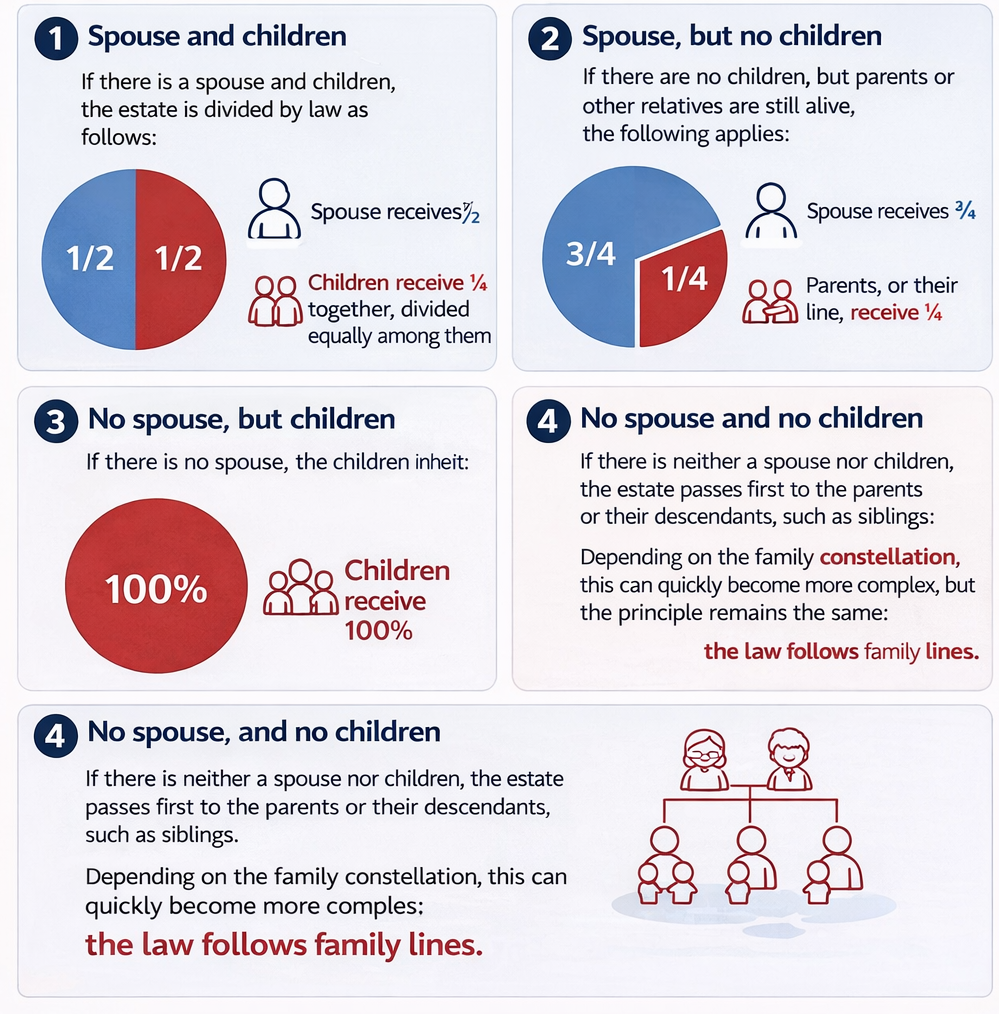
Statutory succession rights depend mainly on two questions:
- Is there a spouse or registered partner?
- Are there children or other descendants?
Spouse and children
If there is a spouse and children, the estate is typically divided by law as follows:
- Spouse receives ½
- Children receive ½ together, divided equally among them
Spouse, but no children
If there are no children, but parents or other relatives are still alive, the following applies:
- Spouse receives ¾
- Parents, or their line, receive ¼
No spouse, but children
If there is no spouse, the children inherit:
- Children receive 100%
No spouse and no children
If there is neither a spouse nor children, the estate passes first to the parents or their descendants, such as siblings. Depending on the family constellation, this can quickly become more complex, but the principle remains the same: the law follows family lines.
Step 2: Statutory entitlement – who is protected?
Since the latest revision of Swiss inheritance law, the rules have become more flexible in certain respects.
Today, statutory entitlement mainly protects:
- Children / descendants
- Spouse / registered partner
Parents are no longer protected by statutory entitlement. This means that if you have no children and your parents are still alive, you may in principle exclude them completely in a will. That is legally possible, even if emotionally it may of course be a different matter.
How large is the statutory entitlement?
The statutory entitlement amounts in each case to one-half of the statutory succession rights:
- Descendants: 1/2 of the statutory succession rights
- Spouse: 1/2 of the statutory succession rights
This also makes clear that statutory entitlement is not a fixed number, but depends on what the statutory succession rights look like in your particular situation.
Step 3: The free portion – how much can I really distribute freely?
Everything that remains after deduction of the statutory entitlement is called the free portion. You may dispose freely of this part in your will.
This becomes easiest to understand through three typical standard cases.
Example 1: Spouse and children
By law, both inherit one-half each. The statutory entitlement is one-half of that in each case:
- Statutory entitlement of the spouse: ¼
- Statutory entitlement of the children together: ¼
- Free portion: ½
What does this mean in practice?
You may allocate up to 50% of your estate freely, for example to a person in a cohabiting relationship, to stepchildren, to a godchild, or to a charitable organisation. However, the statutory entitlement of the spouse and the children must be respected.
Example 2: Spouse, no children (for example, parents still alive)
By law, the spouse receives 3/4. The statutory entitlement is one-half of that:
- Statutory entitlement of the spouse: 3/8 (37.5%)
- Free portion: 5/8 (62.5%)
What does this mean in practice?
Without children, the room for manoeuvre is often significantly greater. Since parents no longer have statutory entitlement, you can structure your estate planning much more freely.
Example 3: Not married, but children
Without a spouse, the children inherit everything by law. The statutory entitlement is one-half of that:
- Statutory entitlement of the children together: 50%
- Free portion: 50%
What does this mean in practice?
If you are unmarried and have children, you can distribute half of your estate freely by will, but at least half must remain with the children.
An important note on cohabitation
Anyone living together unmarried has no statutory inheritance rights without a will. This is one of the most common reasons why people in Switzerland make a will at all: to protect a partner in a cohabiting relationship. This is possible, but typically only within the free portion.
What happens if statutory entitlement is infringed?
If a will falls short of statutory entitlement, there may be a reduction: heirs protected by statutory entitlement may require the dispositions to be reduced until their minimum shares are restored. This often leads to conflict, and that is exactly why careful and clear planning is worthwhile.
Conclusion: the three sentences to remember
First: without a will, the law determines the statutory succession rights.
Second: statutory entitlement sets limits, especially in favour of children and the spouse.
Third: the free portion is your room to plan individually.