
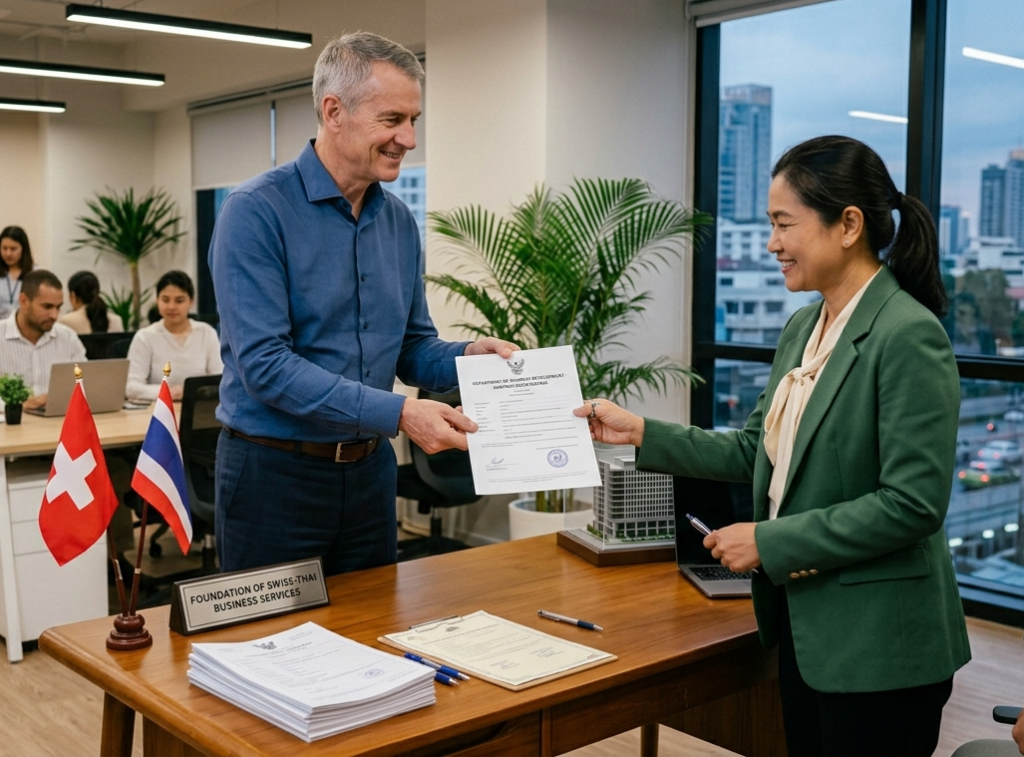
Thailand is an attractive location for many Swiss companies for production and regional expansion in Southeast Asia.
However, if a Swiss company plans to do more in Thailand than merely sell products, it should assess at an early stage whether investment promotion by the Thailand Board of Investment, or BOI, may be available.
BOI promotion can offer significant advantages: tax incentives, customs benefits, facilitated visa and work permit procedures, land use rights and, in many cases, the possibility of full foreign ownership. At the same time, BOI is not suitable for every business model. The critical factors are the specific activity, the planned investment and compliance with the BOI conditions.
This article explains what BOI means, when this route may be worthwhile for Swiss companies, which sectors typically qualify and how the application process works.
What is the BOI in Thailand?
The Thailand Board of Investment is a government investment promotion agency. Its role is to promote direct investment in Thailand, particularly in sectors that contribute to the country’s technological, industrial and sustainable development. Investment promotion is governed by the Investment Promotion Act B.E. 2520.
The BOI does not simply promote a company as a whole. In principle, it promotes a specific investment project. The project must fall within an eligible activity and meet the relevant conditions. The official BOI Investment Promotion Guide provides an overview of these activities.
For Swiss companies, this means that the investor’s Swiss origin is not decisive. What matters is whether the planned Thailand project fits the BOI’s promotion objectives in terms of substance and economic impact.
Why is BOI interesting for Swiss companies?
BOI promotion can be particularly interesting for Swiss companies if Thailand is intended not only as a sales market, but as an operational location.
Typical strategic objectives include:
- establishing a production facility in Thailand;
- relocating certain manufacturing steps from Europe or Asia;
- setting up a regional ASEAN hub;
- establishing an R&D, engineering or testing site;
- manufacturing medical technology, machinery, components or specialised products;
- developing digital services or platforms;
- using Thailand as an export base.
The key point is this: BOI can make market entry more attractive not only from a tax perspective, but also from a corporate and operational perspective. The BOI Guide lists, among other things, tax exemptions, customs duty exemptions, permission to own land, facilitated work visas and the ability to transfer funds abroad in foreign currency.
Who is BOI suitable for?
BOI is particularly suitable for Swiss companies that intend to establish a substantial and eligible business activity in Thailand.
| Suitable for | Why BOI may be relevant |
| Manufacturing companies | Tax exemptions, customs benefits on machinery, export promotion |
| Medtech companies | Medical devices and medical device parts may be eligible for BOI promotion |
| Mechanical engineering and automation | Advanced manufacturing is a classic BOI sector |
| Food-tech and biotech | Agriculture, food, biotechnology and future food are relevant promotion sectors |
| Digital service providers | Certain digital and high-value services may qualify |
| R&D and engineering projects | Research, development, design and testing may be eligible |
| Regional headquarters or service structures | Depending on the function, a BOI structure may be useful |
| Companies requiring foreign specialists | BOI can facilitate visa and work permit procedures |
| Companies with a long-term Thailand strategy | BOI is most worthwhile where there is genuine investment and operational substance |
BOI is particularly interesting for companies that bring machinery, technology, know-how, skilled personnel or capital to Thailand and thereby contribute to Thailand’s prioritised economic sectors.
Who is BOI less suitable for?
BOI is not automatically the right solution for every Swiss company.
| Less suitable for | Why |
| Pure export sales into the Thai market | A company that only sells from Switzerland into Thailand generally does not need and will not usually receive BOI promotion |
| Small local sales offices without an eligible activity | BOI requires an eligible business activity |
| General consulting services | Not every service activity is eligible for BOI promotion |
| Traditional trading companies | Pure trading usually does not fall within the prioritised BOI activities |
| Restaurants, cafés and small retail concepts | These activities generally do not qualify as BOI projects |
| Projects without substantial investment | BOI generally requires a minimum investment and operational substance |
| Short-term test projects | BOI is more suitable for long-term structures and projects |
As a general rule, the BOI Guide provides for a minimum investment of THB 1 million, excluding land costs and working capital, unless a different rule applies to the specific activity. Projects must also, among other things, use modern production or service processes and meet the applicable criteria. In practice, however, the investment should realistically be higher than THB 1 million.
Which sectors may qualify for BOI?
The BOI distinguishes between different groups of eligible activities. For Swiss companies, the following areas are particularly relevant in practice:
| BOI sector | Examples |
| Agriculture, Food & Biotechnology | Food-tech, functional foods, biotechnology, sustainable agricultural technology |
| Medical Industry | Medical devices, diagnostics, pharmaceutical active ingredients, clinical research |
| Advanced Manufacturing | Mechanical engineering, automation, robotics, precision manufacturing |
| Electrical & Electronics | Sensors, electronic components, smart devices |
| Basic & Supporting Industries | Materials, packaging, chemicals, industrial supply |
| Digital & Creative Industries | Software, platforms, digital services, data solutions |
| High-Value Services | R&D, engineering design, testing, training, regional functions |
| Logistics | International distribution centres, modern logistics solutions |
| Sustainability / Industrial Upgrade | Energy efficiency, smart industry, sustainable industrial modernisation |
The BOI list is detailed and contains special conditions for many activities. A case-by-case assessment is therefore always necessary.
What advantages does BOI offer?
The benefits of BOI promotion can be divided into tax incentives and non-tax incentives.
Tax incentives
| Benefit | Meaning |
| Corporate income tax | Exemption or reduction from Thai corporate income tax on profits generated by the promoted project |
| Customs duty exemption for machinery | Exemption or reduction of import duties on machinery |
| Customs duty exemption for raw materials used for export | Customs benefits for raw materials and materials used in export production |
| Promotion measures for research and development materials | Customs benefits for materials used for research and development |
| Additional deductions | Possible for certain costs such as transport, electricity, water or infrastructure |
The tax incentives depend on the BOI activity group:
| Category | Corporate income tax exemption |
| A1+ | 10–13 years, without cap |
| A1 | 8 years, without cap |
| A2 | 8 years |
| A3 | 5 years |
| A4 | 3 years |
| B | No corporate income tax exemption, but other privileges may be available |
For A1+ and A1, a tax exemption without a cap may be available. For A2 to A4, the exemption is generally limited to 100% of the investment value.
Non-tax incentives
For Swiss companies in particular, the non-tax incentives are often especially important.
| Benefit | Practical relevance |
| Majority ownership of the company | In many BOI projects, full or majority foreign ownership is possible |
| Permission to acquire land | BOI may allow land ownership for the promoted project, particularly for manufacturing facilities |
| Visas and work permits | Facilitated deployment of foreign specialists and experts |
| Remittance of funds | Ability to transfer money abroad in foreign currency |
| Support by BOI/OSOS | Advice and coordination with authorities through the investment promotion structure |
BOI vs. Foreign Business License
When entering the Thai market, the question often arises whether BOI promotion or a Foreign Business License, or FBL, is the right route.
The answer depends on the activity.
| BOI Promotion | Foreign Business License | |
| Purpose | Investment promotion for eligible projects | Permission for certain foreign business activities |
| Scope of application | Only for BOI-promoted activities | For certain activities under the Foreign Business Act |
| Tax benefits | Possible | Generally no BOI tax privileges |
| Foreign ownership | Often possible depending on the activity | Depends on the activity and approval |
| Land ownership | Possible within the scope of BOI promotion | No |
| Suitable for | Manufacturing, technology, R&D, high-value services | Activities that are not eligible for BOI but may be licensed |
If a project is eligible for BOI promotion, BOI is often the more attractive route because it may offer not only a market entry solution, but also incentives. If the activity is not eligible for BOI promotion, an FBL or another structure may be required.
Example: Swiss medtech company in Thailand
A Swiss medtech company manufactures high-precision components for orthopaedic instruments or implant systems. The company wants to establish a production or assembly unit in Thailand in order to serve ASEAN customers more quickly while maintaining Swiss quality standards.
A BOI structure could be useful in this case.
| Aspect | Possible BOI relevance |
| Activity | Manufacturing of medical devices or medical device parts |
| BOI sector | Medical Industry |
| Possible incentive group | Depending on the product and activity, A2, A3 or A4 |
| Machinery import | Customs duty exemption on machinery may be economically relevant |
| Specialists | Swiss engineers or quality managers may be deployed more easily |
| Certification | ISO 13485 or an equivalent standard may be required for medical device parts |
| Ownership | Depending on the activity, full foreign ownership may be possible |
| Location | Land ownership may be relevant for factory projects |
The economic benefit does not lie only in the possible tax exemption. For a Swiss medtech company, BOI can be particularly attractive because tax incentives, machinery import, foreign control, land use and the deployment of skilled personnel can be combined within one structure.
How does the BOI application process work?
The BOI application process should be prepared carefully. In practice, the following approach is recommended:
- Review the project: First, assess whether the planned activity falls within a BOI-eligible category.
- Determine the BOI category: Next, analyse which specific BOI activity applies and which conditions must be met.
- Plan the corporate structure: Shareholding, capitalisation, management, location and operational structure should be planned in advance.
- Prepare the documents: These typically include a project description, investment plan, production or service process, machinery list, financial data and technical information.
- Submit the BOI application: The application is generally submitted electronically through the BOI system.
- BOI review and queries: The BOI may ask follow-up questions or request additional explanations.
- Approval/promotion decision: If the decision is positive, the applicant receives a promotion decision, which must be accepted within the applicable deadline.
- Apply for the Promotion Certificate: After acceptance of the resolution, the BOI Promotion Certificate is applied for.
- Implement the project and observe compliance: After receiving the promotion, the conditions must be complied with, deadlines observed and privileges used correctly.
Depending on the size of the project, the BOI Guide provides for different review periods. Where the documents are complete, the review period is generally 40 working days for projects up to THB 200 million, 60 working days for projects exceeding THB 200 million up to THB 2 billion, and 90 working days for projects exceeding THB 2 billion. For the application for the Promotion Certificate, the BOI Guide provides for a deadline of six months after acceptance of the promotion decision.
Conclusion: When is BOI worthwhile for Swiss companies?
BOI is particularly worthwhile for Swiss companies if Thailand is planned as a long-term operational location. BOI is especially attractive for manufacturing, technology, medtech, mechanical engineering, food-tech, biotech, R&D, digital services and high-value regional functions.
BOI is less suitable for purely local small businesses, general trading, pure consulting without eligible substance or short-term test activities.
BOI is not a standard approach for every foreign company. It is a strategic instrument for eligible investment projects. Companies that plan the structure properly can obtain significant benefits. Companies that misjudge the requirements risk delays, unnecessary costs or the loss of incentives.
Nomadlaw supports Swiss companies with legal advice on market entry in Thailand. If you would like to assess whether your Thailand project is BOI-eligible, we would be pleased to advise you.
FAQ: BOI Thailand for Swiss companies
What does BOI mean in Thailand?
BOI stands for Board of Investment. It is Thailand’s investment promotion authority, which can support certain investment projects with tax and non-tax incentives.
Is BOI available for Swiss companies?
Yes. BOI is generally also available to Swiss companies, provided that the planned project falls within an eligible activity and meets the BOI conditions.
Can a Swiss company own 100% of a BOI company in Thailand?
In many BOI-eligible activities, full foreign ownership is possible. However, there are exceptions, particularly where other Thai laws or specific BOI conditions require local participation.
What tax benefits does BOI offer?
Depending on the activity, BOI may grant an exemption from Thai corporate income tax for 3, 5, 8 or up to 10–13 years. In addition, customs benefits may apply to machinery, raw materials or R&D materials.
Is BOI only suitable for large companies?
No. The general minimum investment is often THB 1 million, excluding land costs and working capital, unless a special rule applies. In practice, however, BOI is particularly worthwhile for projects with genuine operational substance.
Which sectors are particularly relevant for Swiss companies?
Particularly relevant sectors include medical technology, mechanical engineering, automation, biotechnology, food-tech, electronics, R&D, engineering, digital services and high-value logistics.
Can Swiss specialists work in Thailand more easily?
Yes. BOI-promoted companies can use facilitated procedures for visas and work permits for foreign specialists and experts.
Can a BOI company own land in Thailand?
Yes. BOI may allow foreign companies to own land for the promoted project. However, this applies within the scope of the BOI conditions and not generally for any purpose.
Which is better: BOI or Foreign Business License?
This depends on the activity. If the project is eligible for BOI promotion, BOI may be more attractive because it can provide not only a market entry structure, but also tax and practical benefits. If the activity is not eligible for BOI promotion, a Foreign Business License or another structure may be required.
Does BOI promotion have to be applied for before company incorporation?
Not necessarily in every case. In practice, however, BOI eligibility should be assessed before incorporation or investment so that the corporate structure, capitalisation and project description are set up correctly.
Does Nomadlaw support BOI market entry?
Yes. Nomadlaw supports Swiss companies with the legal structuring of market entry into Thailand, BOI pre-assessment, coordination with local experts and implementation of a legally sound market entry strategy.