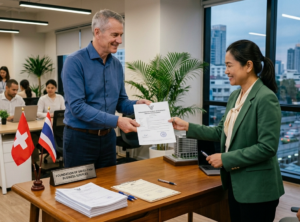

Short answer: Yes, in principle, a Swiss employee can live in Thailand and work remotely from there for a Swiss company. For the Swiss employer, however, this is no longer a simple workation or ordinary home office arrangement, but a permanent cross-border employment structure. This creates significant review obligations and risks, particularly in relation to residence and work permits, taxes, withholding tax, payroll, social security, permanent establishment, employment law, data protection and insurance.
The employer should therefore not allow such an arrangement informally. The key question is not only whether the employee can technically work from Thailand, but whether the company can structure the employment properly from a legal, tax and social security perspective. Without prior assessment, a remote worker permanently living in Thailand may create local registration, contribution, tax or permanent establishment risks for the Swiss company.
Workation or main residence in Thailand: Why is the difference important?
A workation is typically limited in time. The employee remains primarily resident in Switzerland and only works temporarily from Thailand, for example for a few weeks or a few months.
If the employee has their main residence in Thailand, the situation is different. The employee lives permanently or predominantly in Thailand, works regularly from there and physically performs their work outside Switzerland. This is no longer an extended holiday with occasional laptop use, but an international employment model.
For Swiss employers, this means that the question is no longer whether the employee may “work from Thailand for a few weeks”. The real question is whether the company can legally employ a person who lives permanently in Thailand.
Can the employee work in Thailand for a Swiss company?
Thailand generally interprets the concept of “work” broadly. A person who is physically present in Thailand and performs work there for an employer may be considered to be working in Thailand from a Thai perspective, even if the employer is based in Switzerland and the clients are not in Thailand.
This is one of the most important points: the place of work is not only where the employer is located, but also where the employee actually performs the work.
For a Swiss employer, this means that permanent remote work from Thailand should not simply be treated like Swiss home office. It must be checked whether the employee has the correct residence status and whether their activity is permitted in Thailand.
The situation becomes particularly sensitive if the employee does not only perform internal tasks, but also represents the Swiss company externally. This includes, for example, contract negotiations, client support, business development, sales activities, management decisions or responsibility for the Thai market.
Residence and visa issues
If the employee moves their main residence to Thailand and works permanently from there for a Swiss company, tourist status is clearly not suitable. A tourist visa or visa-free entry is intended for temporary private stays and should not be used as the basis for regular full-time employment from Thailand.
The Destination Thailand Visa, or DTV, is also only suitable to a limited extent. The DTV is designed for workations, digital nomads, remote workers, foreign talents and freelancers, and allows longer stays than tourist status. However, it is more geared towards flexible, time-limited stays. It allows stays of 180 days per entry, with a possible extension of another 180 days. After that, the person must leave Thailand and may re-enter within the validity period of the visa.
For an employee who has their permanent main residence in Thailand and works there full-time on a long-term basis, the DTV should therefore not automatically be regarded as a sufficient permanent solution. By leaving Thailand after 180 days and re-entering shortly afterwards, another 180-day stay may theoretically be possible. However, if this is repeated several times, there is a risk that the Thai authorities could view it as circumvention and revoke the visa because it is not intended for a de facto permanent stay. Regardless of this, a person becomes tax resident in Thailand after 180 days.
For long-term remote work structures, the Long-Term Resident Visa, or LTR, should rather be examined. The Work-from-Thailand Professional category is particularly relevant. This category is aimed at foreign employees who live in Thailand and work remotely for an established foreign company.
However, the LTR is not a simple standard solution. The requirements are significantly stricter than for the DTV. As a rule, the employee must prove a personal income of at least USD 80,000 per year over the past two years. If the income is between USD 40,000 and USD 80,000 per year, additional requirements may become relevant, such as a master’s degree, intellectual property or Series A funding.
The employer must also meet certain requirements. The foreign employer must either be a listed company or, as a private company, have existed for at least three years and generated sufficient combined revenue over the past three years. The LTR is therefore particularly suitable for well-paid senior employees, highly qualified specialists or employees of large and established international companies.
For Swiss employers, this means that the LTR can be a suitable solution if both the employee and the Swiss company meet the requirements. However, it should be assessed on a case-by-case basis whether the employee actually falls within the Work-from-Thailand Professional category and whether the specific activity is covered by the LTR status.
Employer of Record as a possible alternative
If the LTR is not suitable, or if the Swiss company needs a local employment structure, an Employer of Record, or EOR, may be considered as a possible alternative.
An EOR is a local service provider that formally acts as the employer and typically handles payroll, the local employment contract, tax deductions, social security contributions and HR administration. For a Swiss company, this can be interesting if the employee lives permanently in Thailand, but the Swiss company does not want to establish its own Thai entity. Yet, it is only suitable if the EOR actually provides sponsorship and work permits for the specific job, and not circumvent the system. A quality check is certainly required to not end up with a risk of non-compliance.
An Employer of Record can therefore be a possible option if the employee lives permanently in Thailand and a local employment structure is required. For Swiss companies, however, this option involves legal, tax and social security risks and should only be implemented after an individual assessment.
Tax residence of the employee in Thailand
A person whose main residence is in Thailand will generally also become relevant for tax purposes in Thailand. Thailand generally treats individuals as tax residents if they stay in Thailand for 180 days or more during a tax year.
In the case of a permanent stay in Thailand, this threshold is quickly reached. This may result in the employee becoming taxable in Thailand. Particularly important is the question of whether the Swiss salary is taxable in Thailand and how the double taxation agreement between Switzerland and Thailand applies.
From a Swiss perspective, the additional question is whether the employee remains tax resident in Switzerland or whether unlimited tax liability in Switzerland ends. This depends on the actual centre of life, residence, family, days of presence and other circumstances.
The employer should therefore not only look at the employment contract, but also examine the tax treatment of the salary.
Payroll costs, social security contributions, unemployment insurance and withholding tax
If an employee permanently has their main residence in Thailand and performs their work entirely physically in Thailand, the Swiss employer should not simply continue Swiss payroll unchanged.
From a Swiss perspective, in this constellation there is generally much to suggest that Swiss social security contributions are no longer due. Mandatory Swiss AHV/IV/EO/ALV coverage normally depends on a person living in Switzerland or working in Switzerland. If the employee neither lives in Switzerland nor physically works in Switzerland, the Swiss contribution obligation usually ceases.
This means: In principle, the Swiss employer no longer has to account for AHV, IV, EO and ALV contributions for this employee. Swiss unemployment insurance also generally does not continue if the employee is no longer subject to the Swiss social security system. The same applies to occupational pension provision and accident insurance: if the employee is no longer subject to the Swiss social security system, the pension fund and accident insurance must also be reassessed or terminated.
The same applies to Swiss withholding tax: if the employee lives in Thailand and performs their work entirely in Thailand, there is generally no Swiss withholding tax obligation on this employment income. The employer is based in Switzerland, but the work is not performed in Switzerland. Swiss withholding tax generally does not have to be deducted in this constellation.
The situation is different if the employee continues to work individual days in Switzerland, receives board of directors’ or executive management compensation from a Swiss company, receives bonus payments for previous Swiss working days, or if other special Swiss connecting factors exist. In such cases, partial Swiss tax or withholding tax liability may become relevant again.
From a Thai perspective, the situation is different. If the employee lives permanently in Thailand and works there, Thailand will regularly become relevant for tax purposes. If the employee stays in Thailand for 180 days or more per tax year, they are generally considered tax resident in Thailand. The Swiss salary may then be taxable in Thailand because the work is physically performed in Thailand.
For the Swiss company, the question is therefore not only whether Swiss charges cease to apply, but also whether Thai obligations arise. In the case of local Thai employment or employment through an Employer of Record, Thai wage tax deductions, social security contributions and payroll reporting obligations would typically arise in Thailand. Thai Social Security generally provides for contributions from both employer and employee.
Direct employment by the Swiss company without a Thai entity and without an Employer of Record is more difficult. In this case, Swiss payroll is no longer appropriate because the employee no longer works in Switzerland. At the same time, the Swiss employer may not easily be able to register as a local employer in Thailand. This creates a practical compliance risk: Swiss contributions may cease to apply, but Thai tax and social security obligations must still be reviewed and properly resolved.
The fact that Swiss contributions may cease to apply does not automatically mean that no contributions are due at all. In the case of permanent work from Thailand, the assessment shifts from Switzerland to Thailand.
Risk of a permanent establishment in Thailand
For the Swiss company, one of the greatest risks is the possible creation of a taxable presence in Thailand.
The risk increases if the employee in Thailand does not only perform internal tasks, but represents the company externally. Particularly sensitive activities include contract negotiations, conclusion of contracts, business development, management functions, local client support, sales or the development of a Thai market.
If the employee performs essential business functions for the Swiss company from Thailand, this may create the impression that the company has a business presence in Thailand. This may trigger tax registration obligations, corporate income tax questions or further regulatory obligations.
A lower-risk structure limits the employee’s activity to internal tasks without authority to represent the company, without local client acquisition and without revenue-generating activities in Thailand.
Employment law and employment contract
If the employee lives permanently in Thailand, the Swiss employment contract should not simply continue unchanged. The employer should check whether an amendment to the employment contract or an addendum is necessary.
Important points include:
- place of work Thailand
- applicable law
- place of jurisdiction
- working hours and time zone
- public holidays and vacation
- salary payment and currency
- taxes and social security
- insurance coverage
- data protection and IT security
- return obligations or termination of the remote work structure
The employer should clearly regulate that work from Thailand is only permitted under certain conditions and that the employee is obliged to immediately report any changes to their residence status, tax situation or work authorisation.
Data protection, IT security and confidentiality
Permanent remote work from Thailand may also trigger data protection and security issues. The employee accesses systems, client data, internal documents or confidential information of the Swiss company from a third country.
The employer should therefore set clear IT requirements. These include VPN, multi-factor authentication, secure devices, restrictions on working on public networks and rules for handling confidential data.
This is particularly important for companies that work with health data, financial data, employee data or other sensitive information.
Health insurance, accident insurance and duty of care
If Thailand becomes the employee’s main residence, insurance coverage must be reassessed. Swiss basic health insurance or travel insurance is often not sufficient for a permanent stay.
The employee needs suitable health and accident insurance for Thailand. The employer should also check whether its accident insurance, daily sickness allowance insurance or other policies cover permanent work from Thailand at all, most likely it will not for permanent worker in Thailand. Employees should be made aware of this fact, and it should be noted that they are responsible for obtaining the necessary insurance coverage themselves.
For the employer, this is also a question of duty of care. What happens in the event of illness, accident, hospitalisation or political crisis? Who bears which costs? Is repatriation covered? Who is responsible if the employee is no longer able to work?
Which structure is best?
There is no single correct solution for all cases. For an employee permanently living in Thailand, four main models are particularly relevant.
First: The employee remains directly employed by the Swiss employer and works entirely from Thailand. This model only makes sense if residence status, taxes, social security, payroll, withholding tax and permanent establishment risks have been properly assessed.
Second: The employee is employed through an Employer of Record in Thailand. This can make sense if a local employment structure is required but no Thai company is to be established.
Third: The Swiss company establishes its own structure in Thailand, for example a company, branch or representative office. This usually only makes sense if the company actually intends to conduct business in Thailand on a longer-term basis.
Fourth: The Swiss company terminates the employment relationship and engages the employee as an external contractor, for example through a limited liability company established by the former employee. This shifts the corresponding employer risks from the Swiss company to the external contractor. However, residual risks remain, and for the employee/external contractor such a solution means additional administrative effort.
Checklist for Swiss employers
Before a Swiss company agrees to a permanent remote work model from Thailand, it should at least review the following points:
- Does the employee have the correct visa and residence status?
- Is remote work from Thailand permitted under this status?
- Is the Long-Term Resident Visa an option?
- Is a local employment structure or Employer of Record required?
- Will the employee become tax resident in Thailand?
- Does the salary have to be taxed or reported in Thailand?
- Do Swiss AHV/IV/EO/ALV contributions cease to apply?
- Does Swiss withholding tax cease to apply?
- Do Thai wage tax or social security obligations arise?
- Does the pension fund have to be terminated or adjusted?
- Does accident insurance coverage continue to exist?
- Could the activity create a permanent establishment in Thailand?
- Does the employee have client contact, authority to sign contracts or revenue responsibility?
- Does the employment contract need to be amended?
- Is data protection ensured?
- Is there sufficient health, accident and insurance coverage?
Conclusion
In principle, a Swiss employee can live in Thailand and work remotely for a Swiss company. For this to be legally and tax compliant, residence status, taxes, social security, employment law and insurance must be carefully reviewed and regulated in advance. Tourist status is not sufficient; visa options such as the Destination Thailand Visa or the Long-Term Resident Visa should be examined. The employer must not allow the situation to continue informally, but must create a clean structure.
Nomadlaw supports companies in structuring international remote work arrangements in a legally secure way and developing suitable solutions for employees with their main residence abroad.
FAQ: Swiss employee with main residence in Thailand
Can a Swiss employee live permanently in Thailand and work for a Swiss company?
In principle, yes. However, the employer must check whether the residence status, tax treatment, social security, payroll and employment law structure are correct.
Is a tourist visa sufficient?
No. Tourist residence status is not suitable for an employee with their main residence in Thailand who works full-time from Thailand on a permanent basis.
Is the Destination Thailand Visa sufficient?
The DTV can be interesting for workations, digital nomads and longer remote work stays. However, for a permanent main residence with full-time work from Thailand, it should not automatically be regarded as a sufficient long-term solution.
Is the Long-Term Resident Visa more suitable?
For certain employees, yes. The Work-from-Thailand Professional category is particularly relevant. It is aimed at people who work remotely for established foreign companies. However, the requirements are demanding, particularly regarding income and the employer profile.
Does the Swiss employer still have to pay AHV, ALV and withholding tax?
If the employee permanently lives in Thailand and works 100% physically from Thailand, Swiss AHV/IV/EO/ALV contributions and Swiss withholding tax are generally no longer due. However, this should be confirmed in advance with the AHV compensation office, the pension fund, the accident insurer and a tax advisor.
Does the employer have to pay contributions in Thailand instead?
This must be assessed. If the employee lives permanently in Thailand and works there, Thai tax and social security obligations may arise. In many cases, this requires a local payroll solution, an Employer of Record or another properly reviewed structure.
What is the greatest risk for the Swiss employer?
The greatest risks are incorrect residence or work status, payroll and social security errors, Thai tax obligations, permanent establishment risks, data protection issues and unclear insurance coverage.